
 By Muzammil Abbasi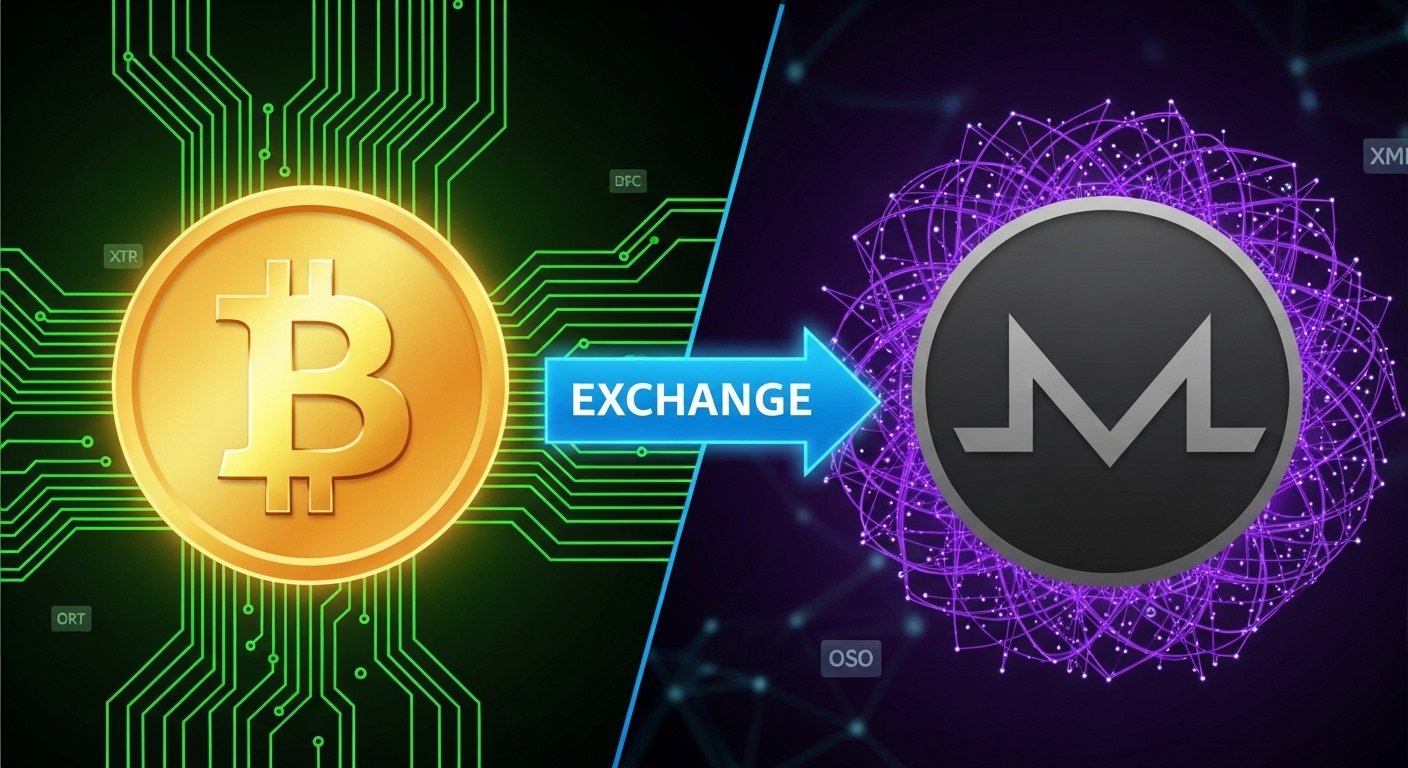
Exchanging Bitcoin (BTC) for Monero is often chosen by users who are becoming more mindful not only of asset values but also of the information that accompanies each transaction. In a blockchain, not only numbers but also data are important. Addresses, connections between transactions, and the history of fund movements can be tracked. In this sense, Bitcoin and Monero (XMR) represent two different approaches to working with information.
BTC is an open ledger, where every transaction remains forever available for analysis. This format is convenient for transparency, but is not always suitable for scenarios where the user wants to minimize the visibility of their actions. XMR, by contrast, was designed as a system in which transaction information is hidden by default. Therefore, exchanging BTC for XMR is often associated not with the market, but with a rethinking of digital security, especially since the conversion can be completed very quickly using an aggregator.
What is the fundamental difference between BTC and XMR?
Bitcoin cryptocurrency gives the user complete control over their funds, but not over the information about their movements. Any external observer can trace the transaction path, link addresses, and draw conclusions about financial activity. Even when using different wallets, a digital trail remains.
The Monero cryptocurrency takes a different approach. Its protocol hides key transaction parameters, making external analysis of fund movements impossible. This is not an additional feature, but a fundamental principle of the network. User privacy is built into the architecture itself.
This is why exchanging Bit Coin for Monero is chosen when it is necessary to:
- break the public link between transactions;
- reduce the amount of information available to external observers;
- use cryptocurrency without disclosing financial activity;
- segregate assets according to different transparency models;
- manage not only funds but also data.
It is important to understand that Monero does not completely replace Bitcoin. Bitcoin remains convenient for savings and general transactions, while XMR is used as a tool for information control. Exchanging them is not a rejection of Bitcoin, but a redistribution of functions.
How does the BTC to XMR exchange work via electronic exchangers?
The Bitcoin to Monero exchange process is built around one key objective: the correct transition between open and closed blockchains. The user pre-determines the amount of BTC to be converted and receives payment in XMR before the transaction begins. This allows for the outcome to be assessed without being subject to market forces or price fluctuations. To receive Monero, an address is used that prevents outside observers from detecting the funds’ receipt. This format is fundamentally different from traditional public Bitcoin addresses and eliminates the possibility of subsequent transaction analysis. After confirming the terms, the exchange service generates unique details for sending BTC.
Bitcoin is sent from the user’s personal wallet. Confirmation on the BTC network can take longer than on most modern blockchains. This is due to the network architecture, not the specifics of the exchange. Once the transaction receives the required number of confirmations, the conversion occurs. Monero transfers occur within the network, where information about the amount, recipient, and source are not publicly available. As a result, XMR arrives in the user’s wallet without creating a new open chain of links to previous Bitcoin transactions.
Electronic exchangers are very convenient for conversion because:
- they allow you to work with private currency without technical setup;
- they do not create open transaction logs;
- they eliminate contact between exchange participants;
- they provide a clear result before funds are sent;
- they ensure a smooth transition between different blockchain models.
What to consider when exchanging BTC for XMR
When working with Monero, it’s important to keep in mind that standard transaction tracking methods are not applicable. Therefore, it’s important to save the order information until it’s completed and use services with a solid reputation. It’s also important to remember that delays during Bitcoin transfer are a characteristic of the BTC network itself. For your first exchange, it’s wise to choose a moderate amount so you can calmly evaluate the entire process.
Exchanging Bitcoin for Monero isn’t simply converting one asset into another, but a conscious transition to a different data model. Electronic exchangers make this process accessible and straightforward, allowing you to enjoy the benefits of private cryptocurrency without delving into technical details. Moreover, choosing an exchanger is very easy if you visit the Bestchange aggregator.